 Coinmarketcap
CoinMarketCap rankings: How Market Cap Affects Coin Rank
CoinMarketCap rankings order eligible cryptoassets primarily by circulating market capitalization, which combines reference price with circulating supply. A coin’s position therefore depends on its own inputs, competing assets, and ranking eligibility. Unit price alone can’t explain the order, and a rising market cap doesn’t always produce a higher rank.
updated
Reading Size, Activity, and Price Performance
Market cap rank compares relative asset size, while volume and percentage-change sorting answer different questions about trading activity and price movement. These measures can produce different orders because they measure different things. A strong price gain doesn’t establish that an asset has overtaken another asset in circulating market value.
The API explicitly distinguishes its methodology-based market cap ranking from a strict numerical market cap sort. It also supports sorting by price, circulating supply, and trading volume. Consequently, a row’s position in a sorted dataset needs the sorting rule beside it. An asset appearing first in a volume-sorted list hasn’t necessarily become the largest cryptocurrency.
Verified Supply Before Rank Interpretation
Verified circulating supply establishes the quantity that CoinMarketCap accepts for ranking, while a project’s self-reported quantity can appear without affecting rank. Circulating supply approximates assets in public hands. Locked tokens, insider allocations, and assets unavailable for public sale are generally excluded; unlocking alone doesn’t necessarily make an allocation circulating. Verification considers distribution information and blockchain data, alongside trading conditions. This distinction explains why multiplying a project-reported supply figure by price may produce a valuation that doesn’t match its ranking.
Eligibility Beyond the Market Cap Calculation
Ranking eligibility determines where an asset can appear even when its calculated market cap exceeds another asset’s valuation.
Top-Rank Requirements
Top 200 eligibility requires verified market capitalization and additional criteria. These cover supply consistency, project evaluation, market depth, a minimum Profile Score, and price consistency. The methodology also evaluates trading venues. CoinMarketCap doesn’t publish every internal threshold, so arithmetic alone can’t establish eligibility.
Other Ranking Tiers
The Top 201-and-beyond tier requires verified market capitalization without the full Top 200 requirements. Assets lacking verified market capitalization fall into an unranked tier sorted by trading volume over 24 hours. These distinctions mean that the displayed order isn’t always one uninterrupted descending list of market cap figures.
The Price and Supply Calculation
Circulating market capitalization equals reference price multiplied by circulating supply. Written symbolically, M = P × S, where M is market cap, P is price per token, and S is the circulating token count. The price currency becomes the market cap currency.
The formula explains why comparing token prices alone produces misleading size comparisons. A lower-priced token can have a larger circulating supply and therefore a larger market cap. Both inputs matter. Small discrepancies in a manual calculation can also reflect displayed rounding or mismatched observation times; multiplying rounded figures won’t necessarily reproduce a value calculated with greater precision.
Can a Coin Rise in Rank While Its Price Falls?
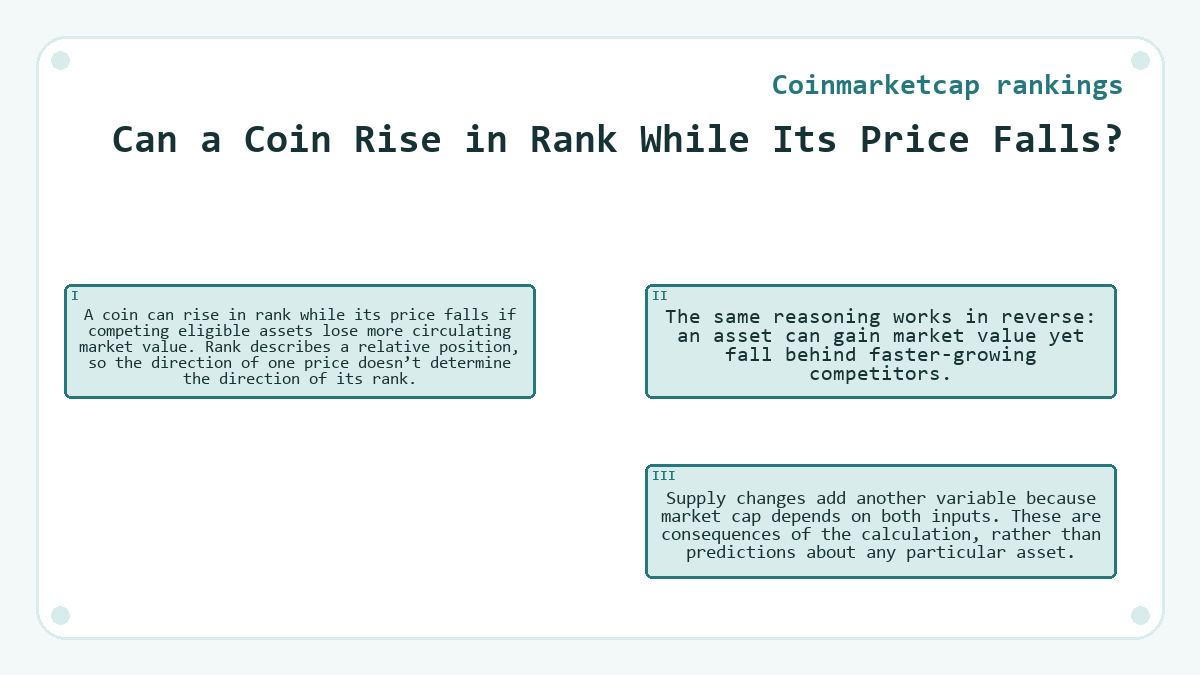
A coin can rise in rank while its price falls if competing eligible assets lose more circulating market value. Rank describes a relative position, so the direction of one price doesn’t determine the direction of its rank. The same reasoning works in reverse: an asset can gain market value yet fall behind faster-growing competitors. Supply changes add another variable because market cap depends on both inputs. These are consequences of the calculation, rather than predictions about any particular asset.
A Comparison With Mismatched Supply Fields
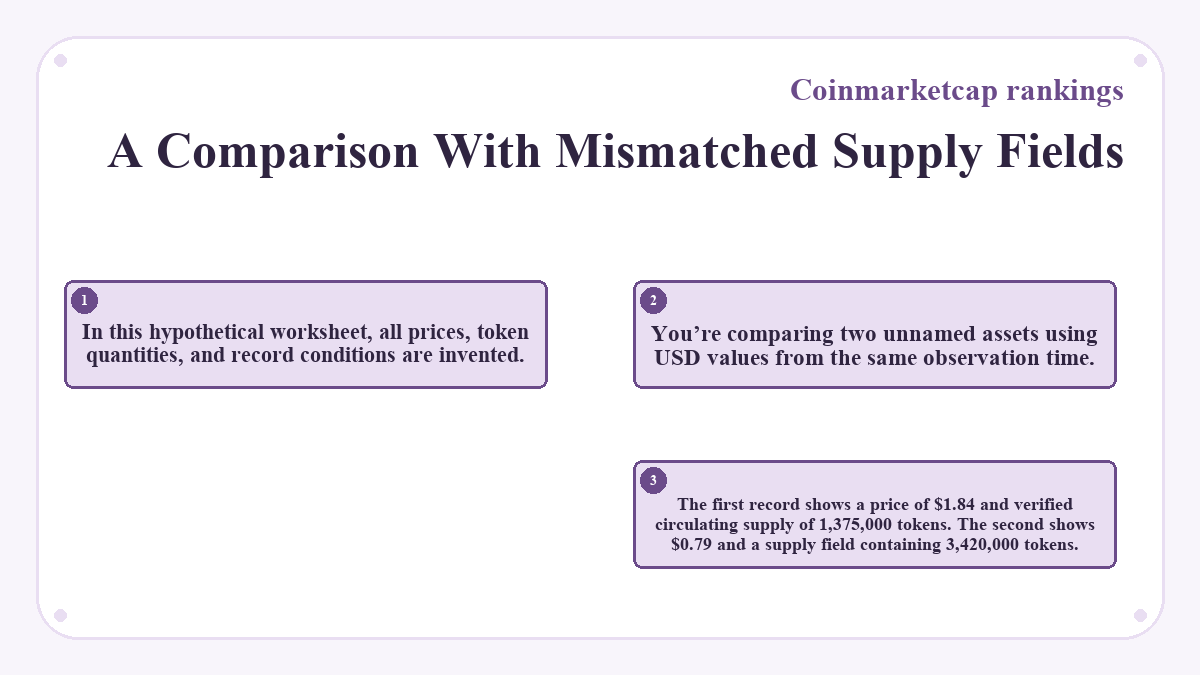
In this hypothetical worksheet, all prices, token quantities, and record conditions are invented. You’re comparing two unnamed assets using USD values from the same observation time. The first record shows a price of $1.84 and verified circulating supply of 1,375,000 tokens. The second shows $0.79 and a supply field containing 3,420,000 tokens.
The first calculation is compatible with circulating market cap: $1.84 × 1,375,000 = $2,530,000. Before calculating the second asset’s comparable value, inspect its supply label. It says total supply. Multiplying it by price gives $2,701,800, but that result uses a different supply basis and can’t settle the comparison.
The second record also contains verified circulating supply of 2,640,000 tokens. Using that quantity gives $0.79 × 2,640,000 = $2,085,600. The first asset’s circulating market cap is therefore $444,400 larger. The initial apparent ordering reverses once both calculations use compatible inputs.
If the second record lacked verified circulating supply, the comparison would remain unresolved. Here, matching supply definitions, currency, and observation time completes the numerical comparison. Actual displayed ranks still require the assets’ eligibility conditions and the rest of the ranked asset set.
Valuation Measures With Different Supply Bases
Circulating valuation and fully diluted valuation answer different questions because they multiply price by different quantities of tokens.
Circulating Market Value
Circulating market value uses the public-float quantity relevant to coin ranking. It supports comparisons of the value assigned to circulating units. Substituting total supply, net of verified burns, changes the valuation basis, even when the resulting number carries a similar market cap label.
Fully Diluted Valuation
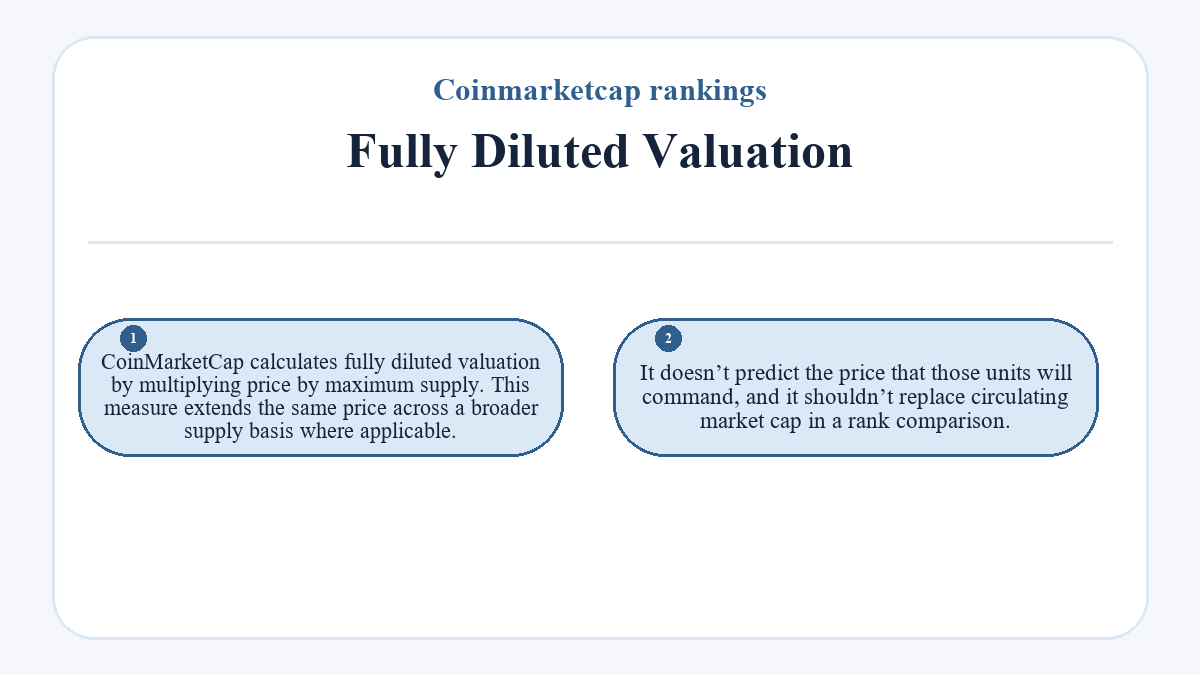
CoinMarketCap calculates fully diluted valuation by multiplying price by maximum supply. This measure extends the same price across a broader supply basis where applicable. It doesn’t predict the price that those units will command, and it shouldn’t replace circulating market cap in a rank comparison.
Market Cap and Executable Liquidity
Market capitalization values circulating units at a reference price; selling those units would require buyers at executable prices. Multiplication doesn’t establish available buying capacity. A large valuation can therefore coexist with limited depth in the market where a sale would occur. Rank alone can’t specify the price available for a particular order, because that requires information about the order and available liquidity. The formula also doesn’t measure cash deposited into the asset: a changed reference price revalues the circulating quantity without requiring every unit to trade.
Comparable Records Across Time
Historical rank comparisons need the asset’s valuation and the surrounding ranking context at each observation. A rank records position without preserving the distance between neighboring assets. Supply revisions, eligibility changes, and changes in the compared asset set can affect that position alongside price movements. Treating every rank change as investment performance loses those distinctions.
A useful record keeps the observation time, rank, price, supply basis, and market cap together. A saved watchlist or portfolio selection identifies which assets matter to you; it doesn’t make observations from different times directly comparable. Keep any unresolved supply or eligibility mismatch visible in the comparison. Otherwise, an apparent change in competitive size may simply reflect a change in what the records measure.
Coinmarketcap rankings questions worth asking
Does Changing the Quote Currency Change the Market Cap Order?
Converting every market cap with the same positive exchange rate preserves their numerical order. Each value increases or decreases by the same factor. That mathematical result assumes the same observation time, asset set, and valuation basis. Comparing figures converted at different times can introduce discrepancies unrelated to the assets’ relative size.
What Does a Large Gap Between Two Rank Numbers Tell Me?
A large rank gap tells you about position, without specifying the difference in market capitalization. Rank spacing isn’t a fixed monetary interval. The market cap gap between neighboring assets varies across the list. To measure relative size, compare their compatible market cap figures rather than subtracting their rank numbers.
Can a Token Burn Guarantee a Higher Market Cap Rank?
A token burn can’t guarantee a higher rank because the effect depends on circulating supply, price, and competing assets. At an unchanged price, reducing circulating supply reduces calculated circulating market cap. A burn outside circulating supply doesn’t directly reduce that input. Any price response is a separate variable, so the burn alone doesn’t determine the ranking outcome.
Would a Token Redenomination Change Its Market Cap by Itself?
A purely proportional redenomination leaves market cap unchanged when price and supply adjust reciprocally. Multiplying the token count by a conversion factor while dividing price by that same factor preserves their product. Mixing the old price with the new supply produces an invalid comparison, even though each figure may have been correct at its own observation time.
Why Might a Wrapped Asset Appear in a Separate Ranking Tier?
CoinMarketCap uses a separate tier for rehypothecated cryptoassets to limit double counting of market capitalization. Wrapped or staked representations can overlap economically with underlying assets, so their placement needs more context than a standalone price-times-supply calculation. Their separate treatment doesn’t establish that their displayed valuation is zero.
Does a Higher Coin Rank Mean My Portfolio Earned More?
A higher coin rank doesn’t establish a gain on your holdings. Rank compares the asset with other eligible assets, while your return depends on acquisition prices, quantities, transaction costs, and subsequent prices. Relative position can improve during a price decline. Portfolio performance therefore needs your holding records rather than rank movement alone.